田忌賽馬
- 田忌赛马
Etymology graph
- inherited
- borrowed
- derived
- parts
- meaning component
- sound component
- related
點擊節點放大 · Click a node to zoom in
Origin
Tian Ji's Horse Race: An Idiom from the Records of the Grand Historian
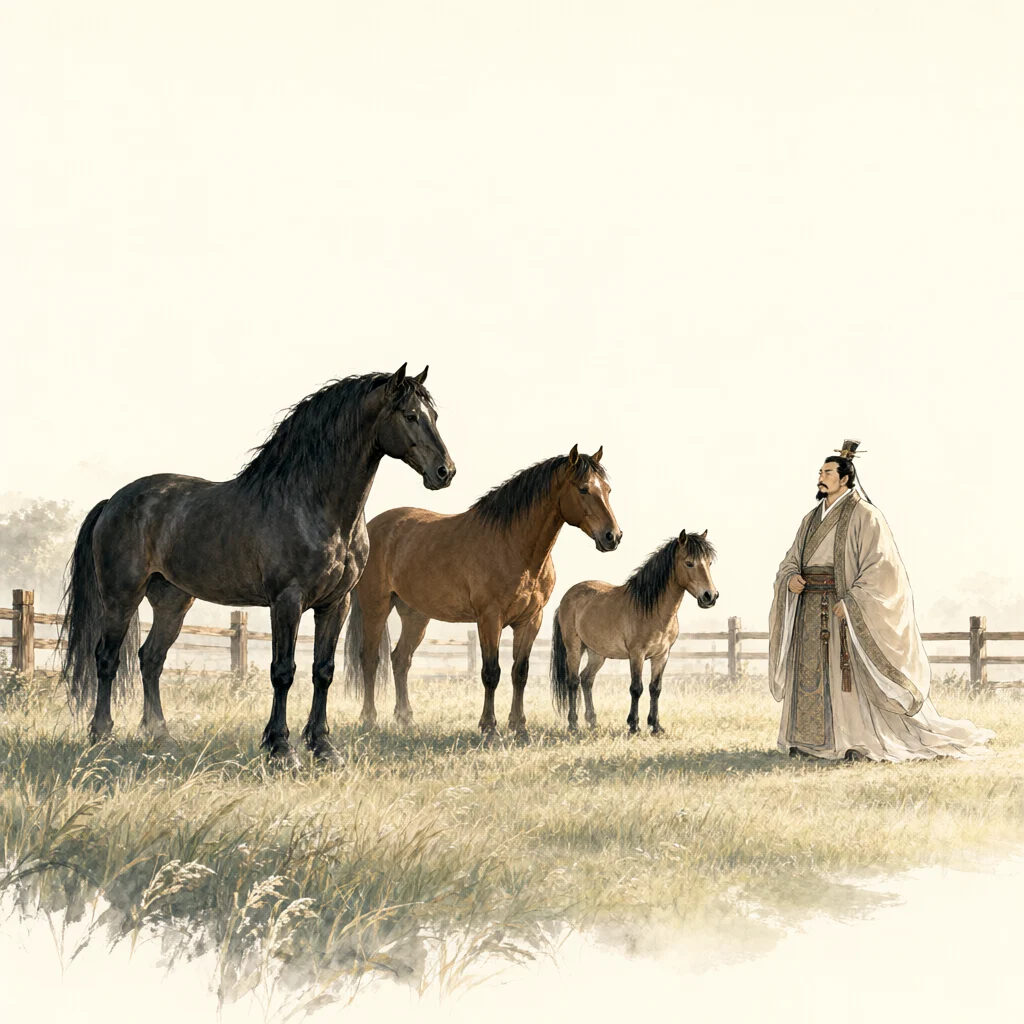
The idiom 田忌賽馬 takes its name from a race in the Shiji (Records of the Grand Historian), the biographies chapter on Sunzi and Wu Qi written by Sima Qian around 91 BCE. Tian Ji, a general of Qi, raced his horses against King Wei and his princes for a thousand pieces of gold. His guest Sun Bin noticed that the horses fell into three grades, upper, middle and lower, and advised him to pair his lower horse against their upper one, his upper against their middle, and his middle against their lower. Tian Ji lost one race and won two, and took the gold. The story ends with Tian Ji recommending Sun Bin to King Wei, who made him his military teacher.
Dictionaries we searched do not list the idiom, so its meaning is taken from the story it names: winning the contest overall by matching one's strengths and weaknesses against the opponent's and accepting a loss where it costs least.
The name 田忌 is a person's name, and its characters are not read as words here.
Confidence: medium · written by claude-haiku-5-5, checked statement-by-statement against the sources below.
田忌賽馬:以長補短,輸小勝大
「田忌賽馬」這個詞由三個部分組成:田忌是人名,指齊國的將領,名字中的「田」是姓、「忌」是名;「賽」是比賽,「馬」是馬匹。成語並不是單純描述賽馬,而是指比賽時把自己的強弱與對手相互比對,在某一場接受較小的損失,從而贏得整體的勝利。證據中沒有任何一部辭典收錄此一成語,它的意義來自其所依據的故事。
故事見於司馬遷《史記·孫子吳起列傳》。齊國將領田忌與齊威王等公子賽馬,賭注是千金。孫臏看出各方的馬匹可分為上、中、下三等,且馬足的速度相差不遠,便建議田忌以下等馬對上等馬、以上等馬對中等馬、以中等馬對下等馬。三場比完,田忌一場輸、兩場贏,最終贏得齊威王的千金。這個故事也因此讓孫臏受到齊威王的重用。
就字形而言,「忌」从心、己聲,「賽」从貝、塞聲,兩字的聲符與形符分別承擔了音與義的部分。不過,成語的整體意義仍須回到《史記》的敘述來理解。
Confidence: high · written by claude-haiku-5-5, checked statement-by-statement against the sources below.
Lineage
- characterChinese田 “farmland (Classifier: 塊/块 m c)”
- characterChinese忌 “to be jealous; to envy; to hate”
- characterChinese賽 “to compete; to contend”
- soundChinese塞 “to stop up; to block up”
- ideaChinese宀 “a type of deep house with walls on all four sides, a roof, a main hall, and back rooms”
- ideaChinese𡨄 “to block; to block up; to jam; to plug”
- ideaChinese工 “labour; work (Classifier: 份 c)”
- ideaChinese土 “earth; soil”
- ideaChinese廾 “both hands”
- meaningChinese貝 “shellfish; cowrie”
- soundChinese塞 “to stop up; to block up”
- characterChinese馬 “horse (Classifier: 匹 m c; 隻/只 m c h mn; 條/条 h)”
Wiktionary etymology text
No etymology text yet. The graph shows what is known from the sources.
Sources
- etymagent (local gemma4:26b) — Generated
- Written form — n/a
- Wiktionary (via Wiktextract / kaikki.org) — CC BY-SA 4.0